0.16
NorthSec 2026
2026
2026-05-14
2026-05-17
4
00:05
https://cfp.nsec.io
America/New_York
Ville-Marie
Opening Ceremony
Opening Remarks
2026-05-14T09:00:00-04:00
09:00
00:15
Welcome to NorthSec 2026!
2026-1096-opening-ceremony
en
false
https://cfp.nsec.io/2026/talk/FBXL8C/
https://cfp.nsec.io/2026/talk/FBXL8C/feedback/
Ville-Marie
Hacking Dumberly
Keynote
2026-05-14T09:30:00-04:00
09:30
00:45
We all hear about APT, but most breaches aren’t really by A (advanced) or P (persistent) threat actors. In this talk, Tim will discuss simple ways for attack and defense, and to show you that often times the “dumb” stuff can be super effective. And as an experienced infosec professional, we can learn a lot of new folks. “Newbs” have valuable insight that isn’t poisoned by “that’s how we’ve always done it” or “this is how X works”. Experienced folks can learn a lot from less experienced folks, and they can go a long way in their development… or than can crush them. Let’s help each other be better.
2026-1063-hacking-dumberly
Tim Medin
en
false
https://cfp.nsec.io/2026/talk/ESRWVG/
https://cfp.nsec.io/2026/talk/ESRWVG/feedback/
Ville-Marie
Private Key Leaks in the Wild: Insights from Certificate Transparency
Talk – Round 1
2026-05-14T10:30:00-04:00
10:30
00:30
Private key leaks represent a critical security vulnerability, with over 600,000 leaked keys on GitHub in 2024, yet their real-world impact remains largely unknown due to the challenge of linking these mathematical objects to their operational usage. We present the first systematic analysis mapping leaked private keys to active certificates, combining GitGuardian's dataset of 945,560 unique leaked private keys with Google's historical Certificate Transparency databases. Our methodology successfully mapped 42,690 private keys to 139,767 certificates, revealing the impact of private keys leaked on GitHub and DockerHub. Using custom online and offline validation, we identified 2,622 valid certificates, enabling website impersonation and MITM attacks. Our analysis reveals systematic failures in certificate revocation practices, with only 80 certificates revoked via CRL/OCSP and just 3 properly marked as key-compromised. Finally, we successfully attributed certificates to 600 organizations across critical industries, though many could not be mapped to identifiable owners. With 20% of valid certificates having been exposed for over two years, our large-scale responsible disclosure campaign sent thousands of emails and revealed significant challenges in reaching certificate owners.
2026-924-private-key-leaks-in-the-wild-insights-from-certificate-transparency
Guillaume ValadonGaetan
en
false
https://cfp.nsec.io/2026/talk/3GZ393/
https://cfp.nsec.io/2026/talk/3GZ393/feedback/
Ville-Marie
Doxxing-proof authentic digital media: trust the asset, protect the source
Talk – Round 1
2026-05-14T11:30:00-04:00
11:30
00:30
We can't trust the images and videos we see online anymore. Recent generative AI improvements support the creation and modification of convincing digital media in quasi real time. We live in an era where these fakes are routinely shared online to influence public opinion, even by elected officials themselves!
Fortunately, technologies exist to embed cryptographic signatures and watermarks in these digital assets, proving their origin. The [C2PA](https://c2pa.org/) specification is being adopted by many technology providers, camera manufacturers, and news media organizations. Major deployments have started in 2025 and will accelerate in 2026.
In high-risk contexts (conflict zones, protests, corruption reporting) creators might be reluctant to share certified images and videos for fear of retribution. Is there a way to reconcile the need for authenticated assets and the privacy of their creators? The answer is yes!
In this talk, we'll explore cryptographic options to provide privacy to those who capture and share digital assets, enabling anonymous yet verifiable content. We'll present an open-source prototype that augments the C2PA specification by using blind signatures and zero-knowledge proofs to hide the signer's identity. These technologies offer the best of both worlds: enabling the public, reporters, and whistleblowers to share sensitive authentic digital media with strong privacy protections, which would increase trust in our content ecosystems.
2026-996-doxxing-proof-authentic-digital-media-trust-the-asset-protect-the-source
Christian Paquin
en
false
https://cfp.nsec.io/2026/talk/NMAM88/
https://cfp.nsec.io/2026/talk/NMAM88/feedback/
Ville-Marie
Living Off The Pipeline: Defensive Research, Weaponized
Talk – Round 1
2026-05-14T13:30:00-04:00
13:30
00:30
For years, we wrote the defensive manuals. We built the "Living Off The Pipeline" (LOTP) inventory and released `poutine` to help you find the vulns. We even spoke at NorthSec about the theoretical risks of Build Pipeline compromise.
We have bad news: **The Threat Actors were "in the room" taking notes.**
In early 2025, we found the "smoking gun." A Threat Actor on BreachForums laid out the full attack plan for a 0-day compromise of a major Open Source project, giving a direct shout-out to our `poutine` scanner and LOTP research as the source. Our defensive work has become their offensive playbook.
In this talk, we stop playing defense.
Introducing **SmokedMeat**: The "Metasploit for CI/CD."
Our research team has a saying: 2025's Build Pipelines look like the average 2005 PHP Web App in terms of secure coding. They are wide open to "pwn requests" and command injections that lead to secrets exfiltration or privilege escalation via overprivileged tokens. SmokedMeat is the first Open Source Red Team framework designed to commoditize these compromises, demonstrating exactly what happens when a Threat Actor turns your infrastructure against you.
We will demonstrate a full exploitation chain: pivoting from unprivileged anonymous access on public repositories to private repository and intellectual property theft, the "gone in 60 seconds" jump from a workflow runner directly to permanent Cloud Admin, and the ability to escape ephemeral job contexts to implant permanent backdoors on your build infrastructure.
The era of "awareness" is over. This talk is a live demonstration of why your current CI/CD security strategy is already obsolete.
2026-928-living-off-the-pipeline-defensive-research-weaponized
François Proulx
en
false
https://cfp.nsec.io/2026/talk/VM3PV8/
https://cfp.nsec.io/2026/talk/VM3PV8/feedback/
Ville-Marie
Hacking Browsers: The Easy Way
Talk – Round 1
2026-05-14T14:15:00-04:00
14:15
00:30
When you think of hacking browsers, you perhaps think of V8 heap exploitation, deep-dive fuzzing, crazy sandbox escapes, and so on. But what if I told you that you can still find vulnerabilities in major browsers that don’t require any technical knowledge? Bugs you can even run into by accident!
In this talk, I’ll take you through my journey of how I “accidentally“ found a vulnerability in Google Chrome. And how that led me to find 2 more vulnerabilities in Chrome as well as 2 vulnerabilities in Mozilla Firefox and many more bugs in other products.
So if you’re keen to find out how I could, with minimal user-interaction, steal your private GitHub repositories, then this talk is for you!
2026-913-hacking-browsers-the-easy-way
Robbe Van Roey
en
false
https://cfp.nsec.io/2026/talk/NUYM7R/
https://cfp.nsec.io/2026/talk/NUYM7R/feedback/
Ville-Marie
From Experts to Everyone: Democratizing Threat Modeling at Ubisoft
Talk – Round 2
2026-05-14T15:00:00-04:00
15:00
00:30
As organizations scale, traditional security review models don’t. Centralized security teams become bottlenecks, threat modeling remains expert-only, and DevOps teams ship designs without structured security insight—creating compounding security debt.
This talk shares how a security team at Ubisoft transformed threat modeling from a niche exercise into an everyday DevSecOps practice now spreading across multiple software development teams.
We’ll walk through the real transformation journey: engaging leadership to recognize the limits of centralized security, designing a shift-left strategy centered on practitioner ownership, and embedding threat modeling from theory into sustained practice.
Beyond mechanics, this session explores the human side of scale: driving adoption without mandate fatigue, selling the "what's in it for me?", and enabling managers and teams to own security outcomes.
You’ll leave with practical lessons, adoption patterns that worked (and failed), and a realistic roadmap for scaling threat modeling in large software organizations—without scaling your security team.
2026-1030-from-experts-to-everyone-democratizing-threat-modeling-at-ubisoft
Kristine Barbará
en
false
https://cfp.nsec.io/2026/talk/8WKDNT/
https://cfp.nsec.io/2026/talk/8WKDNT/feedback/
Ville-Marie
Offensive Security and Threat Modeling, an unlikely collaboration
Talk – Round 1
2026-05-14T15:45:00-04:00
15:45
00:30
Offensive Security and Threat Modeling are two worlds that rarely intersect even in the most mature and security minded organizations. However, they both can be about the same subject, a given system, and the same overarching goal: to improve the security posture of that system.
This talk is the fruition of an unlikely team up of two specialists: one in offensive security, who engages organizations with external pentesting and one in application security, who performs threat modeling as part of the internal software development process.
Both could be working on activities of the same security program, but are they often put in the same room the way they will be put on stage here? Will they fight or end up shaking their heads in unison for consternation? What are the actual gains of having them work to bring together offensive security and threat modeling?
To answer that, we will introduce the foundations for both crafts with obligatory definitions, but also give opinionated takes on goals and value for effectiveness and productive engagements.
By the end of this talk, you’ll see how pentesting can evolve from opportunistic to strategic, and how threat modeling assumptions can be validated, confirmed and prioritized. All that aligned with business needs, and with some much needed collaboration between the two disciplines.
2026-992-offensive-security-and-threat-modeling-an-unlikely-collaboration
Jonathan MarcilMartin Dubé
en
false
https://cfp.nsec.io/2026/talk/EVUEEM/
https://cfp.nsec.io/2026/talk/EVUEEM/feedback/
Ville-Marie
Researchers vs. Threat Actors in Cloud Attacks
Talk – Round 1
2026-05-14T16:30:00-04:00
16:30
00:30
Security researchers push the boundaries of what’s possible. (Nation-state) threat actors push the boundaries of what’s exploitable. In many cases, threat actors adopt public research for their operations, but there are also many examples where threat actors use novel techniques to compromise cloud environments before researchers publish their findings.
In this talk, a cloud security researcher and a threat intelligence analyst team up to explore how cutting-edge cloud attack research is rapidly weaponized by espionage threat groups. We’ll walk through real-world examples where newly published techniques – intended to educate defenders – were adopted and operationalized by nation-state actors targeting cloud environments. The focus of the talk will be on Entra ID and Microsoft 365 attacks, exploring both the technical mechanics behind the tools and techniques, why threat actors are interested in utilizing them and real-world example of research adoption. Examples of techniques cover include device code phishing, authorization code phishing (ConsentFix) and the adoption of open source security tools.
This session highlights how attack paths that may seem highly theoretical at first glance can pose a significant and immediate threat to organizations operating in the cloud. What starts as a proof-of-concept in a blog can quickly become a part of a threat actor’s playbook.
2026-991-researchers-vs-threat-actors-in-cloud-attacks
Dirk-jan MollemaSanne Maasakkers
en
false
https://cfp.nsec.io/2026/talk/J8SQXY/
https://cfp.nsec.io/2026/talk/J8SQXY/feedback/
Ville-Marie
Party du jeudi / Thursday Party
Long Panel
2026-05-14T19:30:00-04:00
19:30
04:00
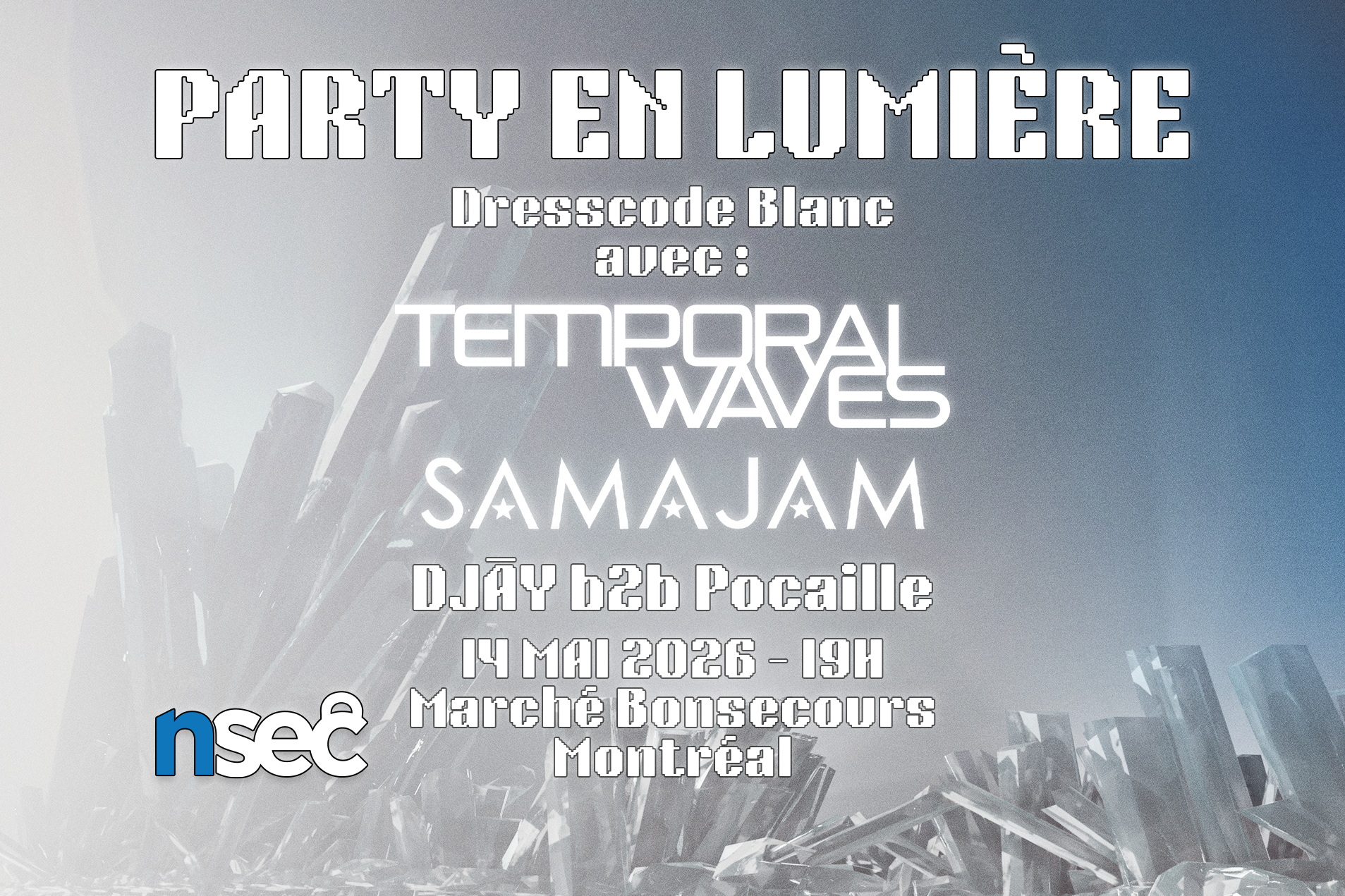
Rejoins-nous pour le party thématique de NorthSec: Party en lumière
Avec :
* Temporal Waves
* Samajam
* DJāy b2b Pocaille
* Cocktails thématiques, incluant des options sans alcool
N'oubliez pas votre tenue Solarpunk/lumineux/blanc.
Les portes ouvrent à 19h
En bonus: Les matchs des Canadiens de Montréal seront diffusés au Marché Bonsecours dès 19h. Billet requis.
//
Join us for the NorthSec themed party: *Party in the Light*
Featuring:
* Temporal Waves
* Samajam
* DJāy b2b Pocaille
* Themed cocktails, including non-alcoholic options
Don’t forget your solarpunk/glowing/white outfit.
Opens at 7 pm
[](https://nsec.io/party/)
Bonus: Montreal Canadiens games will be broadcast at Marché Bonsecours starting at 7 p.m. Tickets required.
[](https://nsec.io/party/)
2026-1095-party-du-jeudi-thursday-party
en
false
https://cfp.nsec.io/2026/talk/KDJV3C/
https://cfp.nsec.io/2026/talk/KDJV3C/feedback/
Workshop 1
Command & Conquer: A hands-on C2 primer for aspiring Red & Blue teamers
3 hr workshop -- Round 1
2026-05-14T10:30:00-04:00
10:30
02:00
Command & Control (C2) is the backbone of modern offensive operations - and one of the most reliable detection opportunities for blue teams.
This hands-on workshop provides a unified view of C2 fundamentals for both offensive and defensive practitioners. Using the open-source Mythic framework, participants will deploy agents, handle callbacks, execute tasking with a focus on opsec, and design real detection logic based on their own generated telemetry.
The session will also cover basic C2 infrastructure design including redirectors and domain fronting, an overview of Mythic agent feature sets, and a high-level comparative analysis of major C2 frameworks used in industry today. Students should leave armed with practical introductory experience operating and detecting C2 activity across multiple platforms.
2026-896-command-conquer-a-hands-on-c2-primer-for-aspiring-red-blue-teamers
Logan MacLarenLewis Moore
en
false
https://cfp.nsec.io/2026/talk/DVMMTU/
https://cfp.nsec.io/2026/talk/DVMMTU/feedback/
Workshop 1
Agentic AI for Threat Hunting
3 hr workshop -- Round 1
2026-05-14T13:30:00-04:00
13:30
03:00
AI agents represent a fundamental shift for security practitioners. They can automate tedious workflows, act as a co-pilot while you build custom tooling that was previously out of reach, and - when integrated into a well-designed system - serve as an intelligent analyst alongside you.
This workshop shows you all three. You'll learn to direct AI agents effectively, then apply those skills to customize and use a complete threat hunting system that combines deterministic processing with AI-assisted analysis.
What You'll Build
A working threat hunting pipeline:
- Endpoint telemetry via Sysmon - process creation, network connections, file operations
- Network telemetry via Zeek - connection logs, DNS queries, HTTP traffic
- A deterministic receptor that harmonizes both sources, correlates events using four-tuple matching, and ranks suspicious activity using DuckDB
- Agent integration where an agent assists with investigation, pattern analysis, and detection refinement
The deterministic layer does the heavy lifting. The agent provides contextual analysis on what surfaces. You make the final call.
What You'll Learn
Beyond the system itself, you'll learn the practices that make agent collaboration effective:
- Structuring projects so agents understand your environment, optimize outputs, and retain "memory"
- Integrating systems that ensure you not only become effective at delivering results, but ensure you continue learning while working with agents ("anti-brainrot systems")
- Context management + intuition - learn how to optimize your interaction with agents
- Learn how to extend agent capabilities, when MCPs are the right call, when they are not
- Agentic coding best practices - staying on top of what's being built, not outsourcing your thinking
- Building reusable skills for repeatable security workflows
- Hooks and guardrails for safe, automated agent operation
Who Should Attend
Threat hunters, detection engineers, SOC analysts, and security practitioners who want to integrate AI agents into their workflow - whether for building tools, automating analysis, or hunting threats.
Requirements
- Laptop with terminal access
- Model access - I will be using Claude Code, but the course is agnostic - you can use any model to provide inference.
2026-968-agentic-ai-for-threat-hunting
Faan Rossouw
en
false
https://cfp.nsec.io/2026/talk/SP8DMH/
https://cfp.nsec.io/2026/talk/SP8DMH/feedback/
Workshop 2
DIY Continuous Security: Practical Security Engineering
3 hr workshop -- Round 2
2026-05-14T10:30:00-04:00
10:30
02:00
There’s no shortage of acronyms being invented every week in the realm of security engineering. Instead of wading through these buzzwords that might not even be around by the end of the year, we’ll dig into the principles that we think make for a good security program. We’ll then apply these principles with practical hands-on exercises where we’ll use free and open source security tools to build continuous security automation and alerting similar to ones we’ve built when starting new security programs.
2026-1057-diy-continuous-security-practical-security-engineering
Mark El-Khoury-
en
false
https://cfp.nsec.io/2026/talk/GU7JDC/
https://cfp.nsec.io/2026/talk/GU7JDC/feedback/
Workshop 2
AWS Security - The Purple Team Way.
3 hr workshop -- Round 1
2026-05-14T13:30:00-04:00
13:30
03:00
Type: Intermediate–Advanced
Focus: Adversary emulation, detection engineering, IR workflows
Style: Fast, offensive-defensive, “learn by attacking and defending”
Cloud platforms like Amazon Web Services (AWS) are foundational to many critical infrastructures and enterprise applications, making them prime targets for attackers. In this session, we will not only explore the most relevant attack vectors cybercriminals use to compromise AWS infrastructures but will also simulate these attacks using known threat actor techniques in an adversary emulation context. From initial access to hardcore persistence, this talk will provide a comprehensive look at how attackers operate in AWS environments.
We will take a technical journey through the tactics, techniques, and procedures (TTPs) employed by attackers at every stage of the threat lifecycle, aligned with the MITRE ATT&CK framework. We’ll start by reviewing common methods of initial access, such as exploiting exposed credentials or vulnerabilities in services like IAM, Lambda, and EC2. From there, we’ll detail how attackers escalate privileges, move laterally, and evade detection from tools like CloudTrail.
The session will conclude with an in-depth look at advanced persistence techniques in AWS, including the manipulation of IAM policies, backdooring Lambda functions or Docker containers, and tampering with logs. Along the way, we’ll demonstrate how security teams can implement defensive and detection strategies to mitigate these risks. By leveraging AWS-native services and third-party tools, attendees will learn how to enhance their incident response capabilities.
This hands-on workshop will give attendees practical, technical insights into AWS security, adversary behavior, and how to better defend against sophisticated, persistent attacks. A full hands-on experience, this presentation ensures deep technical immersion.
Requirements:
Participants should have the following ready before the training:
AWS CLI installed
Terraform installed
GitHub account for cloning lab repos
Knowledge of AWS Security Fundamentals
An email with detailed setup instructions will be sent beforehand.
Provided Material:
Github Repository with the solution to the workshops
Final Notes
This training is designed for security engineers, SOC analysts, incident responders, and anyone who wants to truly understand AWS security through hands-on work. By the end of the session, you’ll have a deep understanding on how real attack and defense techniques work in AWS, being able to understand the hardening requirements, replicate attacks, generate detection use cases, and execute forensic techniques.
2026-864-aws-security-the-purple-team-way-
Santiago Abastante
en
false
https://cfp.nsec.io/2026/talk/E7LDLH/
https://cfp.nsec.io/2026/talk/E7LDLH/feedback/
Workshop 2
Hack ta carrière par Talenty : CV et LinkedIn en tech et cybersécurité 1
3 hr workshop -- Round 1
2026-05-14T16:45:00-04:00
16:45
01:00
Talenty propose « Hack ta carrière », un atelier sur l’optimisation du CV et du profil LinkedIn en tech et cybersécurité. Découvrez comment les recruteurs analysent les profils et repartez avec des actions concrètes pour améliorer votre visibilité.
2026-1094-hack-ta-carrire-par-talenty-cv-et-linkedin-en-tech-et-cyberscurit-1
en
false
https://cfp.nsec.io/2026/talk/RNQHKW/
https://cfp.nsec.io/2026/talk/RNQHKW/feedback/
Salle de bal
A systematic approach to evading antivirus software
Talk – Round 1
2026-05-14T10:30:00-04:00
10:30
00:30
Red teaming and penetration testing are core practices of the cyber security audit landscape. Both of these practices rely on the ability to execute offensive software tools that are normally detected as malicious by antivirus software. To achieve the execution of these tools on systems where antivirus software are installed, operators rely on several techniques to evade detection. In practice, detection evasion is, too often, ill-informed guesswork. A better methodology for evasion would allow for more efficient, and therefore more affordable campaigns thus contributing to more cyberresilient organisations.
This presentation will discuss some of my ongoing Ph.D. research into methodologies for deducing information about detection capabilities present in antivirus software solutions. I propose a black-box approach based on software probes, mutations and the logical implications of their detection to identify antivirus capabilities. Correct identification of these capabilities would allow evasion techniques to be applied intently and minimally, reducing chances of unexpected detections and decreasing time spent on evading antivirus software.
2026-952-a-systematic-approach-to-evading-antivirus-software
Philippe Pépos Petitclerc
en
false
https://cfp.nsec.io/2026/talk/A7MFAX/
https://cfp.nsec.io/2026/talk/A7MFAX/feedback/
Salle de bal
Sold to the highest bidder : the escalation of ADINT from geolocation tracking to intrusion vector
Talk – Round 2
2026-05-14T11:30:00-04:00
11:30
00:30
Is ADINT, *Advertising-based Intelligence*, the new trend for Computer Network Exploitation (CNE) initial access and commercial surveillance solutions ? ADINT defines the exploitation of online advertising processes to collect, correlate, and operationalize large-scale data for intelligence gathering. By weaponizing the advertisement Real-Time Bidding (RTB) process, this technique turns an omnipresent commercial ecosystem into a dual-use surveillance tool.
While initially leveraged for granular geolocation and real-time geofencing through mobile advertising identifiers and metadata correlation, the stakes of ADINT have escalated significantly. It now also serves as an initial access vector for commercial spyware solutions, reshaping the economics of the commercial surveillance vendor (CSV) market as traditional zero-click vulnerabilities become increasingly scarce and costly.
This presentation provides a comprehensive overview of the current ADINT landscape and operational use cases. It will outline the evolution of ADINT and propose a categorization into three operational tiers: *Passive ADINT*, characterized by the passive collection and correlation of RTB bidstream data; *Active ADINT*, which employs on-demand micro-targeting and geofencing for real-time target validation; and *Offensive ADINT*, where the ad delivery mechanism itself is repurposed as a zero-click intrusion vector for initial access.
Based on documented cases, the presentation will also examine how commercial surveillance vendors weaponize ADINT by exploiting the structural opacity of the AdTech industry. By rebranding intrusive monitoring as legitimate analytics, these firms leverage regulatory arbitrage to circumvent dual-use export controls, highlighting the urgent need for stakeholders to adapt their defensive and policy responses.
2026-1048-sold-to-the-highest-bidder-the-escalation-of-adint-from-geolocation-tracking-to-intrusion-vector
Maxime ARQUILLIEREColine C
en
false
https://cfp.nsec.io/2026/talk/MF3UWC/
https://cfp.nsec.io/2026/talk/MF3UWC/feedback/
Salle de bal
Hacking 5G: From Radio Security to the APIs
Talk – Round 2
2026-05-14T13:30:00-04:00
13:30
00:30
5G networks are being opened up at every layer and attackers are paying attention. On the radio interface, we assess what operators actually deploy: is encryption enabled? Is integrity protection enforced on signaling and user plane? Are null ciphers still accepted? How well is the network isolated from external access? These fundamentals still fail more often than you'd think.
The 5G core runs on cloud-native REST-based architectures where a single misconfigured network function can expose subscriber data or provide persistence into critical infrastructure. We demonstrate this live using our open-source 5GC API Pentest Burp Suite extension automating NF discovery, IMSI enumeration, credential extraction, and API fuzzing against a 5G core. OpenRAN disaggregates the radio access network into open interfaces between O-RU, O-DU, O-CU, and the RIC - creating attack surfaces that didn't exist in monolithic base stations. And now CAMARA, the industry initiative exposing network capabilities through standardized APIs, gives third parties access to device location, SIM swap, and number verification, with security models still maturing.
This talk walks through real assessments and attacks at each layer from verifying radio protections to exploiting core APIs and examining how some endpoints could enable surveillance and fraud.
2026-1015-hacking-5g-from-radio-security-to-the-apis
Sébastien Dudek
en
false
https://cfp.nsec.io/2026/talk/QXH9CS/
https://cfp.nsec.io/2026/talk/QXH9CS/feedback/
Salle de bal
Stolen Laptops : Defeating DMA Countermeasures
Talk – Round 1
2026-05-14T14:15:00-04:00
14:15
00:30
This talk will expand on concepts explored in my NSEC 2025 talk "Stolen Laptops : A brief overview of modern physical access attacks"
We will deep-dive into the subject of Direct Memory Access attacks against modern windows operating systems, exploring together some of the primary countermeasures employed to protect computers from physical attackers.
Notably, we will discuss the implementation and interaction of various defensive technology at the physical, firmware, and operating system layers.
This includes things like UEFI security, hardware whitelisting, firmware DMA protection and virtualization features (VT-d, VT-x, AMD-Vi), and their interaction with critical OS layer protection mechanisms including Virtualization-Based Security (VBS) and Kernel DMA Protection. We will discuss techniques used by attackers to neutralize or bypass these mechanisms to enable a DMA attack against Windows 11. Specifically, we will focus on attacks that modify UEFI firmware data to control boot behavior. I will demonstrate novel tradecraft which allows operators to map important security features to the variable stores that control them via a new tool I developed called NVRAMap.
The talk culminates with an in-depth presentation of a another tool I developed called DMAReaper. The tool allows attackers with physical access to Disable Kernel DMA Protection via a pre-boot DMA attack even when a system has all modern protection mechanisms enforced.
We will discuss the research that supported the tool's creation and the precise operations being performed against system RAM in order to locate and destroy the DMAR ACPI table required for Kernel DMA Protection to function. This talk includes a multiple video demonstrations of both tools being used together to compromise a modern workstation running Windows 11.
2026-1010-stolen-laptops-defeating-dma-countermeasures
Pierre-Nicolas Allard-Coutu
en
false
https://cfp.nsec.io/2026/talk/XSJQDE/
https://cfp.nsec.io/2026/talk/XSJQDE/feedback/
Salle de bal
Increasing detection engineering maturity with detection as code
Talk – Round 1
2026-05-14T15:00:00-04:00
15:00
00:30
This talk covers a big Security Operation Center (SOC)’s journey through maturing our detection engineering practice by implementing *detection as code* (DaC) principles.
What we will cover:
1. Our starting point (where a lot of SOCs are): no DaC, manually modifying rules in a SIEM;
2. What is DaC and why it’s a game-changer for detection engineers;
3. Why we chose Sigma as the backbone of our DaC practice;
4. Our gradual transition to DaC
5. A real case study of how Sigma + DaC made changing SIEM so much easier.
Intended audience: people who create or manage detection rules in a SOC, people who want to increase the quality and stability of the rules you maintain and people who are interested in how DevOps principles can be applied to security operations.
2026-946-increasing-detection-engineering-maturity-with-detection-as-code
Émilio Gonzalez
en
false
https://cfp.nsec.io/2026/talk/B3SJZP/
https://cfp.nsec.io/2026/talk/B3SJZP/feedback/
Salle de bal
Mapping Deception Solutions with BloodHound OpenGraph
Talk – Round 1
2026-05-14T15:45:00-04:00
15:45
00:30
Abstract:
Traditional defensive measures alone are proving insufficient against determined adversaries. This talk introduces a systematic approach to implementing effective deception solutions by using BloodHound's OpenGraph framework to map and deploy deceptive attack paths across AD and third-party enterprise technologies.
This talk moves beyond basic honeypots and canary tokens. This presentation demonstrates how to build discoverable deceptions that actually entice attackers. We'll explore how understanding existing attack paths in your environment is crucial to creating believable deceptions that adversaries will naturally encounter and attempt to exploit.
Key Topics Covered:
- Attack Path-Driven Deception Design: Using attack path analysis to identify optimal deception placement points and create realistic adversary scenarios
- OpenGraph for Deception Mapping: Extending beyond Active Directory to model deceptive attack paths across Git repositories, configuration management systems, and cloud services
- Practical Implementation Examples: Live demonstrations including AD CS deception using Certiception, repo-based deceptions with GitHound, infrastructure deceptions through AnsibleHound and SCCMHound
2026-866-mapping-deception-solutions-with-bloodhound-opengraph
Joshua PragerBen Schroeder
en
false
https://cfp.nsec.io/2026/talk/KZX7PR/
https://cfp.nsec.io/2026/talk/KZX7PR/feedback/
Salle de bal
The OpenGraph diary: Attack path management applied to Ansible
Talk – Round 1
2026-05-14T16:30:00-04:00
16:30
00:30
This presentation will focus on AnsibleHound, a collector that adds Ansible WorX and Ansible Tower attack paths to BloodHound. Additionally, we will conduct a thorough exploration of Ansible exploitation and abuse through attack path management. This will enable both attackers and defenders to identify hybrid attack paths.
Our presentation will provide you with three key takeaways:
1. Discovery and offensive knowledge for Ansible exploitation
2. Integrate Ansible in the identity surface using AnsibleHound
3. Hybrid attack paths exploitation between Active Directory, Ansible and Github
2026-994-the-opengraph-diary-attack-path-management-applied-to-ansible
Simon LachkarCharl-alexandre Le Brun
en
false
https://cfp.nsec.io/2026/talk/SFJJJR/
https://cfp.nsec.io/2026/talk/SFJJJR/feedback/
Salle de bal
Podcast PolySécure
Long Panel
2026-05-14T17:15:00-04:00
17:15
01:00
Podcast live sur la scène!
2026-1077-podcast-polyscure
en
false
https://cfp.nsec.io/2026/talk/YVDMCE/
https://cfp.nsec.io/2026/talk/YVDMCE/feedback/
Salle de bal
Lightning Talks
Long Panel
2026-05-14T18:30:00-04:00
18:30
01:00
Short 5 minute talks by the community!
Register [here to give a talk](https://forms.gle/cY9mV5WwfKNJZUG98)
2026-1076-lightning-talks
en
false
https://cfp.nsec.io/2026/talk/GDYZBY/
https://cfp.nsec.io/2026/talk/GDYZBY/feedback/
Activités ponctuelles
Why We Fight Game (CANCELED)
Villages
2026-05-14T10:00:00-04:00
10:00
01:00
Drop in to fight for a solarpunk future at the Why We Fight role-playing village, where game designer Laurie Blake will be facilitating a unique one-shot adventure where Solarpunk Hackers are remotely raiding a data centre! Join us in the Salle de la Commune (Villages) in the basement!
2026-1085-why-we-fight-game-canceled-
en
false
https://cfp.nsec.io/2026/talk/C7MZ8Y/
https://cfp.nsec.io/2026/talk/C7MZ8Y/feedback/
Activités ponctuelles
Simulation d'incident | tabletop exercise TTX
Villages
2026-05-14T11:00:00-04:00
11:00
01:00
T’as envie d’un jeu infosec? Tu rêves d’être membre d’une purple team pendant un incident de sécurité? Tu veux flex tes capacités de gestion ou ton savoir-faire technique? Tu es gestionnaire et tu veux voir les membres de ton équipe interagir entre eux pendant une simulation? Viens essayer nos "table-top exercises (TTX)" animés par notre criminologue Vicky Desjardins. Rendez-vous dans la Salle des Communes (Villages) au sous-sol!
2026-1089-simulation-d-incident-tabletop-exercise-ttx
en
false
https://cfp.nsec.io/2026/talk/7LGCFW/
https://cfp.nsec.io/2026/talk/7LGCFW/feedback/
Activités ponctuelles
Why We Fight Game (CANCELED)
Villages
2026-05-14T12:00:00-04:00
12:00
01:00
Drop in to fight for a solarpunk future at the Why We Fight role-playing village, where game designer Laurie Blake will be facilitating a unique one-shot adventure where Solarpunk Hackers are remotely raiding a data centre! Join us in the Salle de la Commune (Villages) in the basement!
2026-1086-why-we-fight-game-canceled-
en
false
https://cfp.nsec.io/2026/talk/8HSFXK/
https://cfp.nsec.io/2026/talk/8HSFXK/feedback/
Activités ponctuelles
Simulation d'incident | tabletop exercise TTX
Villages
2026-05-14T13:00:00-04:00
13:00
01:00
T’as envie d’un jeu infosec? Tu rêves d’être membre d’une purple team pendant un incident de sécurité? Tu veux flex tes capacités de gestion ou ton savoir-faire technique? Tu es gestionnaire et tu veux voir les membres de ton équipe interagir entre eux pendant une simulation? Viens essayer nos "table-top exercises (TTX)" animés par notre criminologue Vicky Desjardins. Rendez-vous dans la Salle des Communes (Villages) au sous-sol!
2026-1090-simulation-d-incident-tabletop-exercise-ttx
en
false
https://cfp.nsec.io/2026/talk/PGA7T8/
https://cfp.nsec.io/2026/talk/PGA7T8/feedback/
Activités ponctuelles
Why We Fight Game (CANCELED)
Villages
2026-05-14T14:00:00-04:00
14:00
01:00
Drop in to fight for a solarpunk future at the Why We Fight role-playing village, where game designer Laurie Blake will be facilitating a unique one-shot adventure where Solarpunk Hackers are remotely raiding a data centre! Join us in the Salle de la Commune (Villages) in the basement!
2026-1087-why-we-fight-game-canceled-
en
false
https://cfp.nsec.io/2026/talk/WQ8TCG/
https://cfp.nsec.io/2026/talk/WQ8TCG/feedback/
Activités ponctuelles
Simulation d'incident | tabletop exercise TTX
Villages
2026-05-14T15:00:00-04:00
15:00
01:00
T’as envie d’un jeu infosec? Tu rêves d’être membre d’une purple team pendant un incident de sécurité? Tu veux flex tes capacités de gestion ou ton savoir-faire technique? Tu es gestionnaire et tu veux voir les membres de ton équipe interagir entre eux pendant une simulation? Viens essayer nos "table-top exercises (TTX)" animés par notre criminologue Vicky Desjardins. Rendez-vous dans la Salle des Communes (Villages) au sous-sol!
2026-1084-simulation-d-incident-tabletop-exercise-ttx
en
false
https://cfp.nsec.io/2026/talk/CMH97B/
https://cfp.nsec.io/2026/talk/CMH97B/feedback/
Activités ponctuelles
Why We Fight Game (CANCELED)
Villages
2026-05-14T16:00:00-04:00
16:00
01:00
Drop in to fight for a solarpunk future at the Why We Fight role-playing village, where game designer Laurie Blake will be facilitating a unique one-shot adventure where Solarpunk Hackers are remotely raiding a data centre! Join us in the Salle de la Commune (Villages) in the basement!
2026-1088-why-we-fight-game-canceled-
en
false
https://cfp.nsec.io/2026/talk/FYZXJC/
https://cfp.nsec.io/2026/talk/FYZXJC/feedback/
Villages en continu
Les Villages / Our Villages
Villages
2026-05-14T10:00:00-04:00
10:00
07:00
Les activités ci-dessous se déroulent toute la journée au sous-sol, dans la salle de la Commune | Below are all-day activities taking place in the de la Commune room in the basement.
### Ramassage de schwag | Schawg pickup
Viens récupérer tes goodies tel que ton t-shirt et ton badge. Consulte ta commande nSec dans tes courriels, tu y trouveras un code QR pour ces items.
### Atelier d’agriculture urbaine
Apprends les bases du semis pour lancer ton potager urbain. Repars avec ton propre plant !
### Zone pre-CTF | Wiz
[](https://www.wiz.io/)
Viens participer à un Cloud CTF organisé par Wiz ! | Come to a Cloud CTF organized by Wiz!
### Zone pre-CTF | Root-Me PRO
[](https://root-me.pro/)
Profite d'un accès gratuit à la plateforme Root-Me PRO dans la zone pre-CTF. | Enjoy free access to the Root-Me PRO platform in the pre-CTF zone.
### Zone pre-CTF | CTF101
Viens t'entraîner avec un CTF amical non compétitif. Tu pourras bénéficier de l'aide de Simon Nolet, qui pourra t'épauler dans l'installation de ton poste de travail, la réussite de challenges et l'utilisation de l'IA.
### Synthetic Observers - Algorithms for Joy
The current AI infused zeitgeist may have left us with fears of a pervasive surveillance era. But the same mathematical and technological tools can also be used to bring joy and harmony. Inspired by the works of Hayao Miyazaki, this tech-art village explores how local LLMs & Computer Vision technologies can be used to bring wonder to our lives!
### Village de crochetage | Lockpicking village
Débutant ou expert, viens apprendre et pratiquer les principes de la sécurité physique sur une variété de verrous.
### Village radio-fréquences | RF Village
### Village de soudure | Soldering village
Viens agrémenter ton badge de trucs électroniques qui clignotent en les soudant toi-même!
### Foulab Montréal hackerspace
The goal of foulab is to provide its members an environment and resources that allow them to exchange knowledge, ideas and explore new technologies. To that end, the organization will arrange a space which allows its users to collaborate.
### Observatoire UQAM
Présentation du rapport des cyberincidents de la Chaire Raoul-Dandurand. Viens poser tes questions à nos chercheurs!
### Musée badges électroniques | Badge museum
Exposition d'une collection de badges depuis 2018
2026-1078-les-villages-our-villages
en
false
https://cfp.nsec.io/2026/talk/U93KAD/
https://cfp.nsec.io/2026/talk/U93KAD/feedback/
CTF
CTF Registration // Enregistrement
CTF
2026-05-15T19:00:00-04:00
19:00
01:00
Setup your table, connect to the VPN, update your OS, rage because IPv6 does not work on your machine...
Installez-vous, connectez-vous au VPN, mettez à jour votre ordinateur, fâchez-vous qu'IPv6 ne fonctionne pas sur votre ordinateur...
2026-1064-ctf-registration-enregistrement
en
false
https://cfp.nsec.io/2026/talk/SNWWZG/
https://cfp.nsec.io/2026/talk/SNWWZG/feedback/
CTF
CTF Day 1 // CTF jour 1
CTF
2026-05-15T20:00:00-04:00
20:00
06:00
CTF
2026-1065-ctf-day-1-ctf-jour-1
en
false
https://cfp.nsec.io/2026/talk/QTKLFT/
https://cfp.nsec.io/2026/talk/QTKLFT/feedback/
Ville-Marie
Lost in the AI Woods: Why the Future Still Needs You -- A Dual Keynote
Keynote
2026-05-15T09:00:00-04:00
09:00
00:30
AI is reshaping cybersecurity and the modern workforce faster than most of us can track —
automating analysis, writing code, simulating attacks, and raising the bar on what it means to be
effective. For professionals, two questions keep surfacing: Am I still relevant? How do I keep
up?
This dual keynote addresses both directly.
In the first half, Salini reframes AI as the ultimate force multiplier for experienced practitioners
— not a threat, but a new frontier to own. Drawing on historical parallels and field evidence, she
makes the case for shifting from a reactive posture to an opportunistic one, and reclaiming the
hacker's original edge: curiosity.
In the second half, Varsha tackles the reality of an always-on world where rising expectations
make it harder to slow down - more tools, more updates, and a constant push to move
faster.Through practical insights and real-world examples, her talk focuses on moving beyond
reactive urgency, offering a more intentional approach in a world that never truly powers down.
Two perspectives. One complete map for anyone navigating the age of AI
2026-1075-lost-in-the-ai-woods-why-the-future-still-needs-you-a-dual-keynote
Varsha DwarakanathanSalini Mishra
en
false
https://cfp.nsec.io/2026/talk/CUYXEF/
https://cfp.nsec.io/2026/talk/CUYXEF/feedback/
Ville-Marie
Commit, Push, Compromise: Attacking Modern GitHub Orgs
Talk – Round 1
2026-05-15T10:00:00-04:00
10:00
00:30
GitHub gives attackers something they love: a place where identity, automation, and production changes meet. Once they’re in, the path from “read access” to “shipping malicious code” can be disturbingly short.
In this talk, we walk through realistic attack paths into GitHub organizations, starting with initial access techniques like device-code phishing and the abuse of trusted GitHub Apps (including the GitHub CLI). From there, we explore how different credential types enable access long-lived Personal Access Tokens that often persist on developer machines, and short-lived automation credentials like `GITHUB_TOKEN` that can still leak through logs, artifacts, or misconfigured workflows and then be leveraged to move laterally or expand privileges.
We highlight tactics we’ve developed and researched post-initial access: how you can abuse sensitive workflows, exploit approval and review dynamics, and find paths around policy guardrails like “protected” pipelines and code-signing rulesets. We’ll also discuss tradeoffs attackers make to reduce forensic visibility and delay detection in environments where GitHub’s native telemetry is limited.
We close with practical defender takeaways: detection strategies and response playbooks focused on the signals that matter and how to improve monitoring coverage in the places GitHub is hardest to observe.
Attendees will leave with a shared framework that’s useful on both sides of the table. Defenders will get a checklist for reducing risk across identities, tokens, integrations, and Actions workflows plus concrete ideas for building higher-signal detection and response in places where visibility is lacking. Red teams will gain a realistic map of where GitHub controls tend to break down in practice, along with a set of hypotheses to test during assessments that go beyond “find a secret in a repo.” The goal is to walk out with sharper intuition for how small weaknesses chain into meaningful impact, and practical ways to either validate that risk (red teams) or eliminate it (blue teams) without grinding delivery to a halt.
2026-955-commit-push-compromise-attacking-modern-github-orgs
Max CMAndrew Buchanan
en
false
https://cfp.nsec.io/2026/talk/FGDWWG/
https://cfp.nsec.io/2026/talk/FGDWWG/feedback/
Ville-Marie
Trust me, I'm a Shortcut - new LNK abuse methods
Talk – Round 1
2026-05-15T10:45:00-04:00
10:45
00:30
Windows shortcut (.LNK) files have remained a popular attack vector over several decades, yet their underlying format is still largely archaic and remains the "gift that keeps on giving" by presenting new opportunities for abuse, even in 2026.
If you believe minor bypasses like adding spaces to an LNK's target (CVE-2025-9491) are the limit of LNK exploitation, this session will change your mind.
We will show previously undocumented LNK techniques that actually allow for more deceptive payload delivery/command execution. We will look at why these new techniques 'work', compare them to existing LNK tricks, and discuss the implications for defenders.
The research methodology behind these new findings, which involved black-box testing of Microsoft's LNK implementation, will be discussed during this session; demonstrating how adopting the "hacker's mindset" helped uncover these LNK tricks.
Next to this, this session will introduce an open-source tool designed to assist security professionals, red teams, and researchers in generating and experimenting with advanced LNK payloads. This tool aims to enhance the ability to simulate and defend against shortcut-based attacks, thereby improving Windows endpoint security.
2026-916-trust-me-i-m-a-shortcut-new-lnk-abuse-methods
Wietze
en
false
https://cfp.nsec.io/2026/talk/EEVWC9/
https://cfp.nsec.io/2026/talk/EEVWC9/feedback/
Ville-Marie
Red Teaming Mindset and Methodology
Talk – Round 2
2026-05-15T11:30:00-04:00
11:30
00:30
Red teaming exercises differ from traditional penetration tests due to their stealthy, goal-driven approach. In this talk, we will cover years of red teaming methodology and the mindset that sets red teamers apart. We will explore gathering information without detection, adapting lateral movement techniques, customizing publicly available toolsets, implementing evasion techniques that actually work, using tricks to get phishing campaigns past modern detection systems, abusing cloud features, and more.
This is all about the mindset and the technical methodology required to succeed as a red teamer.
It also highlights the different challenges red teamers face during red team engagements versus traditional penetration tests. Both red teamers and testers can learn from the approach used during red team exercises.
2026-1047-red-teaming-mindset-and-methodology
Charles F. Hamilton (Mr.Un1k0d3r)
en
false
https://cfp.nsec.io/2026/talk/93NN8Q/
https://cfp.nsec.io/2026/talk/93NN8Q/feedback/
Ville-Marie
A Needle in a Haystack: Identifying an Infostealer Attack Through Trillions of Events in a Large-scale Modern SOC
Talk – Round 1
2026-05-15T13:30:00-04:00
13:30
00:30
Security Operation Centers (SOCs) are used by companies to defend themselves against cyber-attacks. These SOCs monitor logs collected from the enterprise network such as process activity, authentication events and netflow, to identify attacks or compromises. These security teams must navigate numerous alerts generated from a wide range of security controls using both rules and Machine Learning (ML) to identify malicious activity. This is even more so the case in large-scale SOCs, or for companies offering Managed Detection and Response (MDR).
This talk showcases a multi-step approach used in a modern large-scale managed SOC that manages thousands of enterprise networks, demonstrating how it can successfully identify a real infostealer attack through multiple layers of filtering and processing. Through a two-week period containing 9.7 trillion event logs, the presented approach combines alert deduplication, individual rule-based and ML based detectors, alert suppression, and a supervised ML based alert prioritization model to dramatically reduce the noise, so that security analysts can pinpoint the infostealer activity.
2026-974-a-needle-in-a-haystack-identifying-an-infostealer-attack-through-trillions-of-events-in-a-large-scale-modern-soc
François Labrèche
en
false
https://cfp.nsec.io/2026/talk/DTUSDL/
https://cfp.nsec.io/2026/talk/DTUSDL/feedback/
Ville-Marie
Measuring AI Ability to Complete Long Cybersecurity Tasks
Talk – Round 1
2026-05-15T14:15:00-04:00
14:15
00:30
In March of 2025, the Model Evaluation & Threat Research (METR) group introduced **AI task time horizons** as a method for measuring the length of tasks that models can autonomously complete coherently. They demonstrated rapid growth in capabilities across frontier systems: effectively showing a doubling every \~7 months. While this framework has primarily been applied to general software and knowledge work, its implications for adversarial domains remain largely unexplored.
In this talk, I present work I've done with **Sean Peters and Jack Payne,** extending METR’s methodology to **offensive cybersecurity workflows**, alongside a complementary **human baseline study** to ground and interpret model performance.
Motivated by the desire to better understand offensive model capabilities, we assembled realistic multi-step offensive task sequences by leveraging a suite of industry standard benchmarks. Both human participants and frontier models were evaluated across increasing task lengths to quantify sustained autonomy, coherence, and failure modes.
Initial results indicate that AI task horizons in offensive cyber are already meaningful and extending rapidly. In several domains, models can chain complex tool-driven actions resembling early-stage intrusion playbooks rather than isolated exploitation steps. The human study provides critical context, highlighting where models approach or diverge from human performance as task length increases.
The talk will cover the experimental design, empirical findings, and key limitations, emphasizing how horizon-based evaluation combined with human grounding surfaces trends that may not be observable by standalone, static benchmarks.
Finally, this work is positioned as **exploratory research**. It raises questions about whether similar horizon trends appear in defensive workflows: how could we measure defensive task horizons, and what methods would allow meaningful comparisons to offensive performance? If the trend does not replicate in defense, what interventions, tooling, or policy changes could help close the gap? This framing invites further investigation and provides a roadmap for research and practitioner engagement in understanding and mitigating offense–defense asymmetries under AI automation.
2026-1003-measuring-ai-ability-to-complete-long-cybersecurity-tasks
Jeremy Miller
en
false
https://cfp.nsec.io/2026/talk/KACS9T/
https://cfp.nsec.io/2026/talk/KACS9T/feedback/
Ville-Marie
Teaching AI to Secure Code: How LLMs Deploy Security Frameworks at Scale
Talk – Round 1
2026-05-15T15:00:00-04:00
15:00
00:30
Security vulnerabilities often stem from misusing operating system or third-party APIs. The traditional solution—wrapping dangerous functions with secure-by-default frameworks—works beautifully in theory but fails at scale. How do you migrate thousands of call sites across multiple applications when each requires understanding developer intent and choosing appropriate security controls?
For over a decade, Meta's security team built approximately 15 secure-by-default frameworks for Android, each designed to prevent specific vulnerability classes. These frameworks were elegant, well-designed, and... underutilized. The deployment bottleneck wasn't technical merit; it was practical scalability. Manual migration was impossibly slow. Deterministic static analysis required massive engineering investment and still struggled with precision. Simple pattern matching was fast but dangerously error-prone.
This talk reveals how we solved this problem using generative AI, specifically Llama models, to automatically suggest and apply security framework migrations across Meta's codebase. The solution isn't just faster—it unlocks scalability that was previously impossible.
2026-898-teaching-ai-to-secure-code-how-llms-deploy-security-frameworks-at-scale
tanu jain
en
false
https://cfp.nsec.io/2026/talk/FCKFCD/
https://cfp.nsec.io/2026/talk/FCKFCD/feedback/
Ville-Marie
Adventures in Process Injection (How I Accidentally Built a Debugger - Again!)
Talk – Round 1
2026-05-15T15:45:00-04:00
15:45
00:30
Have you ever wondered how to run code inside a different process? Or, for that matter, why you would WANT to run code in another process?
I originally entered the security world writing cheats for Windows games - Starcraft, Warcraft II, and similar late-90s games. The tools are functionally lost to the ages, but the techniques I used have served me for years: not only can you use process injection to cheat at video games, it's useful for so much more: adding, changing, bypassing, or even calling code in a foreign process can help with fuzzing, reverse engineering, malware detection, and so much more!
But for a technique so commonly used, there isn't really a "standard" way to do it, especially on Linux!
One day, I read a blog discussing how hard it was to do on Linux. I thought, "that can't be right, it's easy on Windows!" and set out to prove them wrong. Days later, I had accidentally written a debugger and learned way, way too much about the ptrace API and /proc filesystem!
In this talk, I'll demonstrate the tooling I built and why it might be more useful than you might think to do this yourself!
2026-957-adventures-in-process-injection-how-i-accidentally-built-a-debugger-again-
Ron Bowes
en
false
https://cfp.nsec.io/2026/talk/RD9TAK/
https://cfp.nsec.io/2026/talk/RD9TAK/feedback/
Ville-Marie
Practical AWS Antiforensics
Talk – Round 1
2026-05-15T16:30:00-04:00
16:30
00:30
What’s more frightening than a 0-day? A series of false negatives combined with the false sense of security in an unprepared Security Operations Team.
Today, most AWS detection and response strategies rely on CloudTrail and GuardDuty, with logs shipped to a SIEM, the heart of security monitoring. But few teams account for the complexity of this supply chain: multiple moving parts, permissions, policies, and inevitable delays. These blind spots create opportunities for attackers to quietly dismantle detection controls.
In this demo-driven talk, I’ll explore the concept of Cloud Antiforensics. Using a real scenario with AWS API calls shipped to Datadog and a decoupled GuardDuty instance reporting to Discord, I’ll show how an attacker can disrupt log collection and evade detection within the delay window.
The goal is not just to demonstrate attacks, but to raise awareness: centralizing everything in a SIEM is not enough. We must design anti-antiforensics mechanisms that operate independently, ensuring resilience even when attackers target the detection pipeline itself.
2026-863-practical-aws-antiforensics
Santiago Abastante
en
false
https://cfp.nsec.io/2026/talk/FG7TGU/
https://cfp.nsec.io/2026/talk/FG7TGU/feedback/
Ville-Marie
Closing Ceremony
Opening Remarks
2026-05-15T17:00:00-04:00
17:00
00:00
The end of the 2026 conference!
2026-1100-closing-ceremony
en
false
https://cfp.nsec.io/2026/talk/HUCZSJ/
https://cfp.nsec.io/2026/talk/HUCZSJ/feedback/
Workshop 1
Shellcoding the Unshellable: Process Hooking & Advanced Shellcoding in Hardened Go Containers
3 hr workshop -- Round 2
2026-05-15T10:00:00-04:00
10:00
02:30
In the rush to adopt modern cloud architectures, organizations often prioritize velocity over security, leaving critical gaps in their infrastructure. This workshop bridges the gap between offensive exploitation and defensive engineering, using a real-world scenario deployed on Google Cloud Platform (GCP).
Participants will be given access to a "production-grade" environment managed with InfraStream, a manifest-driven infrastructure platform. Inside this environment lies a set of microservices written in Go, which appear functional but contain a critical flaw: a Server-Side Template Injection (SSTI) vulnerability. However, the infrastructure is hardened: The server runs in a scratch-based container with some very restrictive network rules that prevents both bind and reverse shell from being effective.
The workshop is divided into two phases:
The Red Team Phase: Attendees will get their hands dirty analyzing the Go server binary. The goal? Get a fully interactive shell on the underlying container. While the initial vulnerability is pretty simple to exploit, the real challenge here lies in leveraging it through the hardening, which will involve hooking the server's code and advanced shellcoding to implement a backdoor.
The Blue Team Phase: Once the compromise is confirmed, we will switch gears to remediation. We will modify InfraStream's manifests to apply practical defense-in-depth strategies. The goal from here will be to implement additional defenses to prevent the process injection attack used in the red team phase.
By the end of this session, attendees will have a deep understanding of linux process injection techniques/hooking, techniques to leverage vulnerabilites in hardened infrastructure and how to leverage infrastructure-as-code to enforce security baselines that make even vulnerable applications resilient to attack. They will also learn specificities regarding Go reverse engineering and how to interact with Go code using assembly.
2026-1040-shellcoding-the-unshellable-process-hooking-advanced-shellcoding-in-hardened-go-containers
Ashley ManrajPhilippe Dugre(zer0x64)
en
false
https://cfp.nsec.io/2026/talk/ZZWHUC/
https://cfp.nsec.io/2026/talk/ZZWHUC/feedback/
Workshop 1
Hardware RE: a gentle intro
3 hr workshop -- Round 1
2026-05-15T13:30:00-04:00
13:30
03:00
In this hands on workshop students will get a chance to investigate an unknown PCB and follow a process of reverse engineering its function and assembly. No prior hardware experience is needed. Bring your own laptop with windows and USB-A ports.
2026-854-hardware-re-a-gentle-intro
Ben GardinerColin deWinter
en
false
https://cfp.nsec.io/2026/talk/VPN8YT/
https://cfp.nsec.io/2026/talk/VPN8YT/feedback/
Workshop 1
Examen radio amateur - Ham Radio Exam
2 hr workshop -- Round 2
2026-05-15T17:00:00-04:00
17:00
02:00
Come get your certification!
2026-1092-examen-radio-amateur-ham-radio-exam
en
false
https://cfp.nsec.io/2026/talk/3AYHXK/
https://cfp.nsec.io/2026/talk/3AYHXK/feedback/
Workshop 2
The Ransomware Negotiation Lab
3 hr workshop -- Round 2
2026-05-15T10:00:00-04:00
10:00
02:30
Ransomware negotiation is often framed as a simple decision... to pay or not to pay that is the question... But in practice, it is a structured coercive exchange conducted under a lot of pressure, incomplete information, and deliberate psychological manipulation and lies.
The Ransomware Negotiation Lab is a three-hour, hands-on workshop designed to simulate the mechanics of modern cyber extortion. Participants will work through a realistic ransomware scenario built around a fully developed Data Leak Site aka a DLS, stage data disclosures, and negotiation transcripts modeled on observed threat actor behaviour and data.
Rather than reviewing theory alone, attendees will actively analyze leak site posts to evaluate the credibility of proof packs. identify attacker leverage points, and conduct guided negotiations exercises in small groups. The lab will also look at timed scenarios to add simulated pressure on escalating ransom pressure, media inquires, partial data releases, and secondary extortion threats will require participants to adapt their strategy in real-time.
2026-1037-the-ransomware-negotiation-lab
Tammy Harper
en
false
https://cfp.nsec.io/2026/talk/EHTKLY/
https://cfp.nsec.io/2026/talk/EHTKLY/feedback/
Workshop 2
Hack ta carrière par Talenty : CV et LinkedIn en tech et cybersécurité 2
3 hr workshop -- Round 1
2026-05-15T13:00:00-04:00
13:00
01:00
Talenty propose « Hack ta carrière », un atelier sur l’optimisation du CV et du profil LinkedIn en tech et cybersécurité. Découvrez comment les recruteurs analysent les profils et repartez avec des actions concrètes pour améliorer votre visibilité.
2026-1093-hack-ta-carrire-par-talenty-cv-et-linkedin-en-tech-et-cyberscurit-2
en
false
https://cfp.nsec.io/2026/talk/SHPUCD/
https://cfp.nsec.io/2026/talk/SHPUCD/feedback/
Salle de bal
Internet Blackout 2026 in Iran — Next-Level Internet Censorship: A Technical Breakdown of Techniques and Tactics.
Talk – Round 1
2026-05-15T10:00:00-04:00
10:00
00:30
Internet shutdowns are often described as a single action — “turning the Internet off.” In practice, they are the result of carefully orchestrated, multi-layered technical controls applied across national infrastructure. Building on my previous talk at BSides, which introduced the fundamental mechanisms of Internet censorship and shutdowns, this session presents a deeper and more comprehensive technical analysis of the 2026 Internet blackout in Iran.
This talk treats large-scale censorship not as a political phenomenon, but as a network engineering and security operation. We examine who has the technical authority to execute shutdowns, how different censorship techniques are layered and coordinated, and when specific tactics are selectively deployed to maximize impact while maintaining internal network functionality.
The analysis spans multiple layers of the stack. At the routing level, we examine BGP route withdrawals, path manipulation, and international transit isolation. At the access and transport layers, we analyze ISP-level service suppression, mobile network data blackouts, and traffic throttling. At the protocol and application layers, we explore deep packet inspection (DPI), protocol fingerprinting, encrypted traffic degradation, and selective blocking of VPNs, QUIC, and TLS-based services.
Special attention is given to the role of national intranet architectures, which allow domestic services to remain reachable while international connectivity collapses, creating the illusion of partial availability. The session also addresses the technical limits of alternative access methods, including satellite Internet, and why such technologies are not a universal solution under state-scale controls.
Using timelines, traffic behavior, and protocol-level indicators, the talk demonstrates that modern Internet shutdowns are graduated, adaptive, and measurable rather than binary events. Attendees will learn how these techniques manifest on the wire, how they can be detected from inside and outside the affected region, and why many common circumvention strategies fail under coordinated, nation-state enforcement.
This presentation is intended for security professionals, network engineers, and researchers interested in Internet resilience, censorship measurement, and large-scale network interference, offering a technically grounded continuation of prior research and real-world observations.
2026-931-internet-blackout-2026-in-iran-next-level-internet-censorship-a-technical-breakdown-of-techniques-and-tactics-
Reza Sharifi
en
false
https://cfp.nsec.io/2026/talk/EZULC3/
https://cfp.nsec.io/2026/talk/EZULC3/feedback/
Salle de bal
Cybermenaces géopolitiques au Canada : État des lieux et perspectives stratégiques
Talk – Round 2
2026-05-15T10:45:00-04:00
10:45
00:30
Que ce soit la Chine, la Russie, la Corée du Nord, l’Iran ou encore Israël, le Canada demeure année après année une cible significative de la cyberconflictualité, agitant l’espace numérique mondial. Entre campagne de cyberespionnage, d’opérations d’influence en ligne ou encore de tentatives de cybersabotage, le cyberespace n’a jamais eu une place aussi prépondérante sur la sphère géopolitique que depuis les dernières années.
Recensant les cyberincidents à caractère géopolitique ayant touché le Canada depuis 2010, l’observatoire des conflits multidimensionnels de la Chaire Raoul-Dandurand présente annuellement depuis 2021 un rapport faisant un état de lieux de ces derniers, répondant aux questions les plus notables sur le sujet : Quels sont les types de cyberincidents les plus fréquents? Quelles sont les cibles connues? Quels groupes de pirates ont visé le Canada? Mais également et avant tout ; d’où proviennent ces attaques?
Cette conférence aura comme objectif de présenter en avant-première les résultats du rapport de 2026, présentant ainsi les grandes tendances de l’année 2025, ses nouveautés, mais également les nouveaux défis rencontrés.
Dans un premier temps, nous nous pencherons sur le type d’incident avec le plus de représentation depuis la création du répertoire ; le cas du cyberespionnage et les particularités de ceux-ci pour l’année qui vient de passer.
Dans un second temps, nous analyserons un phénomène qui, déjà que bien présent lors des années antérieures, à réellement vu un boom cette année ; les cas de campagne de manipulation de l’information avec une analyse pour la première fois d’un cas d’hypertrucage sexuel au sein d’une campagne de ce type.
Dans un troisième et dernier temps, nous parlerons d’une tendance qui semble s’accentuer depuis les dernières années, mais qui se recense pour la première fois de manière publique en sol canadien ; les cas de cybersabotage.
2026-1061-cybermenaces-gopolitiques-au-canada-tat-des-lieux-et-perspectives-stratgiques
Philippe Marchand
en
false
https://cfp.nsec.io/2026/talk/38ALV8/
https://cfp.nsec.io/2026/talk/38ALV8/feedback/
Salle de bal
Le futur s'invente avant-hier
Talk – Round 1
2026-05-15T11:30:00-04:00
11:30
00:30
En 1865, Jules Verne envoie des hommes sur la Lune depuis la Floride. En 1969, Apollo 11 décolle de Cap Canaveral. En 1984, William Gibson décrit le cyberespace comme une "hallucination consensuelle". Quarante ans plus tard, nous y vivons. La science-fiction n'est pas une prédiction — c'est un laboratoire d'idées où le futur se prototype avant d'exister.
Cette conférence propose un voyage entre imaginaire et innovation, entre les pages des romans d'hier et les laboratoires d'aujourd'hui.
Dans un premier temps, nous revisiterons quelques anticipations célèbres : les tablettes tactiles de Star Trek, les oreillettes de Fahrenheit 451, la vidéosurveillance de 1984, les voitures autonomes de Total Recall.
Puis nous plongerons dans des innovations moins médiatisées mais plus disruptives. Que pouvons-nous puiser dans la Science-Fiction pour deviner ce que notre futur proche nous réserve avec les découvertes actuelles : IA générative, calcul quantique.
Enfin, nous explorerons un territoire encore plus radical : l'informatique biomoléculaire. Des chercheurs travaillent aujourd'hui sur des systèmes de calcul qui se nourrissent de sucre et de lumière. Stockage de données dans des molécules, calcul biologique, interfaces vivantes — nous sommes à l'aube d'une révolution dont peu de gens mesurent l'ampleur. Là encore, que nous raconte les grandes imaginations sur ces sujets en devenir ?
Pour conclure, nous combinerons ces briques pour imaginer des scénarios possibles. Certains existent déjà dans la littérature de science-fiction. D'autres restent à écrire. Vous repartirez j'espère avec l'envie d'identifier les futurs souhaitables et ceux que nous voulons éviter.
Car penser le futur n'est pas un luxe intellectuel. C'est une responsabilité. En tant que technologues, chercheurs, hackers, citoyens, nous avons le pouvoir d'orienter la trajectoire. La science-fiction d'hier est la science d'aujourd'hui. La science-fiction d'aujourd'hui sera le monde de nos enfants.
Le futur ne se prédit pas. Il se choisit.
2026-964-le-futur-s-invente-avant-hier
Xavier Facélina
en
false
https://cfp.nsec.io/2026/talk/S9798K/
https://cfp.nsec.io/2026/talk/S9798K/feedback/
Activités ponctuelles
Simulation d'incident | tabletop exercise TTX
Villages
2026-05-15T10:00:00-04:00
10:00
01:00
T’as envie d’un jeu infosec? Tu rêves d’être membre d’une purple team pendant un incident de sécurité? Tu veux flex tes capacités de gestion ou ton savoir-faire technique? Tu es gestionnaire et tu veux voir les membres de ton équipe interagir entre eux pendant une simulation? Viens essayer nos "table-top exercises (TTX)" animés par notre criminologue Vicky Desjardins. Rendez-vous dans la Salle des Communes (Villages) au sous-sol!
2026-1081-simulation-d-incident-tabletop-exercise-ttx
en
false
https://cfp.nsec.io/2026/talk/GYNLQB/
https://cfp.nsec.io/2026/talk/GYNLQB/feedback/
Activités ponctuelles
Why We Fight Game (CANCELED)
Villages
2026-05-15T11:00:00-04:00
11:00
01:00
Drop in to fight for a solarpunk future at the Why We Fight role-playing village, where game designer Laurie Blake will be facilitating a unique one-shot adventure where Solarpunk Hackers are remotely raiding a data centre! Join us in the Salle de la Commune (Villages) in the basement!
2026-1091-why-we-fight-game-canceled-
en
false
https://cfp.nsec.io/2026/talk/SZFSHF/
https://cfp.nsec.io/2026/talk/SZFSHF/feedback/
Activités ponctuelles
Simulation d'incident | tabletop exercise TTX
Villages
2026-05-15T12:00:00-04:00
12:00
01:00
T’as envie d’un jeu infosec? Tu rêves d’être membre d’une purple team pendant un incident de sécurité? Tu veux flex tes capacités de gestion ou ton savoir-faire technique? Tu es gestionnaire et tu veux voir les membres de ton équipe interagir entre eux pendant une simulation? Viens essayer nos "table-top exercises (TTX)" animés par notre criminologue Vicky Desjardins. Rendez-vous dans la Salle des Communes (Villages) au sous-sol!
2026-1082-simulation-d-incident-tabletop-exercise-ttx
en
false
https://cfp.nsec.io/2026/talk/CS7MJA/
https://cfp.nsec.io/2026/talk/CS7MJA/feedback/
Activités ponctuelles
Why We Fight Game
Villages
2026-05-15T13:00:00-04:00
13:00
01:00
Drop in to fight for a solarpunk future at the Why We Fight role-playing village, where game designer Laurie Blake will be facilitating a unique one-shot adventure where Solarpunk Hackers are remotely raiding a data centre! Join us in the Salle de la Commune (Villages) in the basement!
2026-1083-why-we-fight-game
en
false
https://cfp.nsec.io/2026/talk/UU3J3Z/
https://cfp.nsec.io/2026/talk/UU3J3Z/feedback/
Activités ponctuelles
Simulation d'incident | tabletop exercise TTX
Villages
2026-05-15T14:00:00-04:00
14:00
01:00
T’as envie d’un jeu infosec? Tu rêves d’être membre d’une purple team pendant un incident de sécurité? Tu veux flex tes capacités de gestion ou ton savoir-faire technique? Tu es gestionnaire et tu veux voir les membres de ton équipe interagir entre eux pendant une simulation? Viens essayer nos "table-top exercises (TTX)" animés par notre criminologue Vicky Desjardins. Rendez-vous dans la Salle des Communes (Villages) au sous-sol!
2026-1080-simulation-d-incident-tabletop-exercise-ttx
en
false
https://cfp.nsec.io/2026/talk/FUFZHK/
https://cfp.nsec.io/2026/talk/FUFZHK/feedback/
Villages en continu
Les Villages / Our Villages 2
Villages
2026-05-15T10:00:00-04:00
10:00
05:00
Les activités ci-dessous se déroulent toute la journée au sous-sol, dans la salle de la Commune | Below are all-day activities taking place in the de la Commune room in the basement.
### Ramassage de schwag | Schawg pickup
Viens récupérer tes goodies tel que ton t-shirt et ton badge. Consulte ta commande nSec dans tes courriels, tu y trouveras un code QR pour ces items.
### Atelier d’agriculture urbaine
Apprends les bases du semis pour lancer ton potager urbain. Repars avec ton propre plant !
### Zone pre-CTF | Wiz
[](https://www.wiz.io/)
Viens participer à un Cloud CTF organisé par Wiz ! | Come to a Cloud CTF organized by Wiz!
### Zone pre-CTF | Root-Me PRO
[](https://root-me.pro/)
Profite d'un accès gratuit à la plateforme Root-Me PRO dans la zone pre-CTF. | Enjoy free access to the Root-Me PRO platform in the pre-CTF zone.
### Zone pre-CTF | CTF101
Viens t'entraîner avec un CTF amical non compétitif. Tu pourras bénéficier de l'aide de Simon Nolet, qui pourra t'épauler dans l'installation de ton poste de travail, la réussite de challenges et l'utilisation de l'IA.
### Synthetic Observers - Algorithms for Joy
The current AI infused zeitgeist may have left us with fears of a pervasive surveillance era. But the same mathematical and technological tools can also be used to bring joy and harmony. Inspired by the works of Hayao Miyazaki, this tech-art village explores how local LLMs & Computer Vision technologies can be used to bring wonder to our lives!
### Village de crochetage | Lockpicking village
Débutant ou expert, viens apprendre et pratiquer les principes de la sécurité physique sur une variété de verrous.
### Village radio-fréquences | RF Village
### Village de soudure | Soldering village
Viens agrémenter ton badge de trucs électroniques qui clignotent en les soudant toi-même!
### Foulab Montréal hackerspace
The goal of foulab is to provide its members an environment and resources that allow them to exchange knowledge, ideas and explore new technologies. To that end, the organization will arrange a space which allows its users to collaborate.
### Observatoire UQAM
Présentation du rapport des cyberincidents de la Chaire Raoul-Dandurand. Viens poser tes questions à nos chercheurs!
### Musée badges électroniques | Badge museum
Exposition d'une collection de badges depuis 2018
2026-1079-les-villages-our-villages-2
en
false
https://cfp.nsec.io/2026/talk/CWNZZV/
https://cfp.nsec.io/2026/talk/CWNZZV/feedback/
CTF
CTF Day 2 + Breakfast by Corsek / CTF jour 2 et déjeuner par Corsek
CTF
2026-05-16T08:00:00-04:00
08:00
02:00
🥐 ☕ 🥯 🧃 Breakfast thanks to Corsek! Déjeuner gracieuseté de Corsek!
CTF re-opens.
Le CTF rouvre.
2026-1066-ctf-day-2-breakfast-by-corsek-ctf-jour-2-et-djeuner-par-corsek
en
false
https://cfp.nsec.io/2026/talk/QFFAKS/
https://cfp.nsec.io/2026/talk/QFFAKS/feedback/
CTF
CTF Day 2 // CTF jour 2
CTF
2026-05-16T10:00:00-04:00
10:00
09:30
CTF
Les rafraichissements sont offerts par Shopify! Venez leur parler au bar si vous êtes à la recherche d’un emploi. / Beverages are provided by Shopify. Come and see them at the bar if you are looking for work.

2026-1067-ctf-day-2-ctf-jour-2
en
false
https://cfp.nsec.io/2026/talk/KMGPMD/
https://cfp.nsec.io/2026/talk/KMGPMD/feedback/
CTF
Pre-Hockey Pizza by Okiok
CTF
2026-05-16T19:30:00-04:00
19:30
00:30
Pizza will be given thanks to Okiok!
De la pizza sera donnée, gracieuseté d'Okiok!

2026-1070-pre-hockey-pizza-by-okiok
en
false
https://cfp.nsec.io/2026/talk/HGCJTN/
https://cfp.nsec.io/2026/talk/HGCJTN/feedback/
CTF
Canadiens Hockey Game Stream / Stream de la partie des Canadiens
CTF
2026-05-16T20:00:00-04:00
20:00
03:00
We will stream the hockey game (in French) in the big screen in salle Ville-Marie. Le CTF reste ouvert pendant ce temps.
On va diffuser la partie de hockey sur écran géant dans la salle Ville-Marie! Le CTF reste ouvert pendant ce temps.
[](https://nsec.io/party/)
2026-1098-canadiens-hockey-game-stream-stream-de-la-partie-des-canadiens
en
false
https://cfp.nsec.io/2026/talk/NF7LRE/
https://cfp.nsec.io/2026/talk/NF7LRE/feedback/
CTF
Costume Contest
CTF
2026-05-16T23:00:00-04:00
23:00
00:30
C'est le retour du CONCOURS DE COSTUME ! On veut voir vos plus beaux costumes thématiques !
Le CTF est FERMÉ pendant ce temps.
//
The COSTUME CONTEST is coming back! We want to see your most beautiful and creative themed costumes!
CTF is CLOSED during this time.
2026-1068-costume-contest
en
false
https://cfp.nsec.io/2026/talk/ZQGF3Q/
https://cfp.nsec.io/2026/talk/ZQGF3Q/feedback/
CTF
Hacker Jeopardy
CTF
2026-05-16T23:30:00-04:00
23:30
01:30
The classic Hacker Jeopardy at NorthSec.
2 rounds of 3 teams of 3 participants will answer weird, niche and funny questions in a Jeopardy!-style friendly contest. Then, a final round with the previous round's winners and NorthSec staff. Grab a drink and take a break from the CTF with us!
Le CTF est FERMÉ pendant ce temps.
//
Le Hacker Jeopardy classique de NorthSec.
2 rondes de 3 équipes de 3 participants vont répondre à des questions étranges, obscures et drôles dans une compétition amicale de style Jeopardy! Ensuite, il y a une ronde finale avec les gagnants des rondes précédentes et des bénévoles de NorthSec. Prennez un verre et une pause du CTF avec nous!
CTF is CLOSED during this time.
2026-1069-hacker-jeopardy
en
false
https://cfp.nsec.io/2026/talk/BBJ8FD/
https://cfp.nsec.io/2026/talk/BBJ8FD/feedback/
CTF
CTF Day 2 (continued) / CTF jour 2 (suite)
CTF
2026-05-17T01:00:00-04:00
01:00
01:00
CTF
2026-1099-ctf-day-2-continued-ctf-jour-2-suite-
en
false
https://cfp.nsec.io/2026/talk/JAF3UR/
https://cfp.nsec.io/2026/talk/JAF3UR/feedback/
CTF
CTF Day 3 + Breakfast // CTF jour 3 et déjeuner
CTF
2026-05-17T08:00:00-04:00
08:00
02:00
🥐 ☕ 🥯 🧃 Breakfast! Déjeuner!
CTF re-opens.
Le CTF rouvre.
2026-1072-ctf-day-3-breakfast-ctf-jour-3-et-djeuner
en
false
https://cfp.nsec.io/2026/talk/ZXTHZD/
https://cfp.nsec.io/2026/talk/ZXTHZD/feedback/
CTF
CTF Day 3 // CTF jour 3
CTF
2026-05-17T10:00:00-04:00
10:00
05:00
CTF
2026-1073-ctf-day-3-ctf-jour-3
en
false
https://cfp.nsec.io/2026/talk/C7D8HY/
https://cfp.nsec.io/2026/talk/C7D8HY/feedback/
CTF
CTF Closing Ceremony // Cérémonie de clôture du CTF
CTF
2026-05-17T15:30:00-04:00
15:30
01:00
Closing speech by the NorthSec crew. The CTF winners will be announced here. // Discours de fermeture par l'équipe de NorthSec. Les gagnant-e-s du CTF seront annoncé-e-s ici.
2026-1074-ctf-closing-ceremony-crmonie-de-clture-du-ctf
en
false
https://cfp.nsec.io/2026/talk/YDWQEN/
https://cfp.nsec.io/2026/talk/YDWQEN/feedback/